


Who needs therapy when you have a sledgehammer?
“Most people resort to therapy. But you chose the brave option. A sledgehammer.” Thus begins the haunting, wholly engrossing narrative of Virtue and a Sledgehammer. Developed by Selkie Harbour and Deconstructeam and published by Devolver Digital, Virtue and a Sledgehammer challenges players to consider the concepts of life, belonging, free will, and the very messy nature of humanity. As main character Pratelle, players return to their hometown to deal with the consequences of the digitization of her community. Nina, Pratelle’s sister and antagonist, has convinced the entire town to digitize their consciousness and upload themselves into robot bodies.
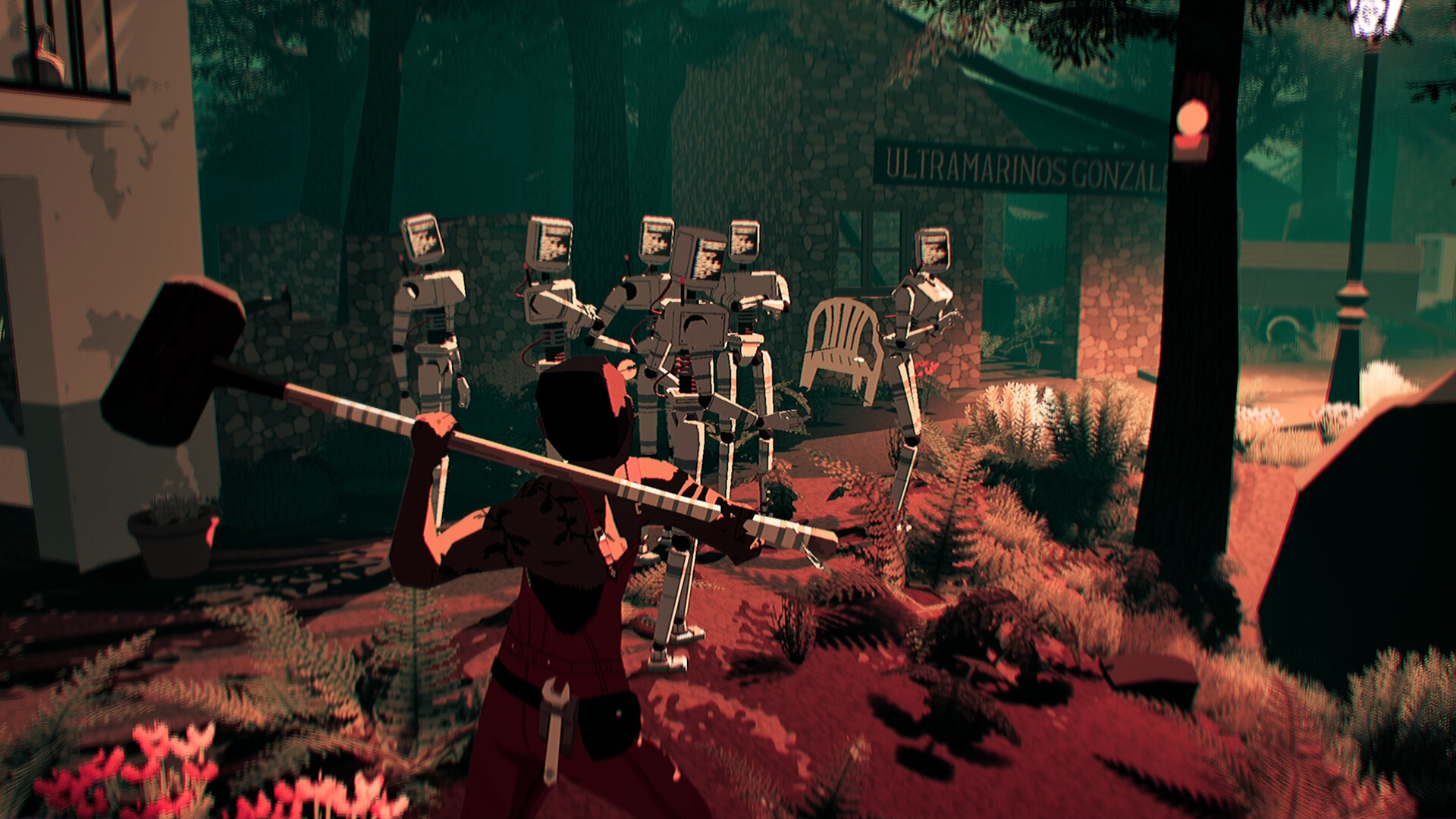
Each robot looks exactly alike, a vertical monitor-like head and traditional human like body. Children are represented by smaller robots and there are some larger, more aggressive robots towards the end of the game. There is a general sense of unease as you confront these robots over the course of the story. Their personalities were left intact during the digitization process and most of them are generally quite unhappy with Pratelle and her quest to demolish and destroy. The dialogue is raw and very human, complete with all of the ugliness that entails. And while there are some former citizens who try to explain to Pratelle why they are happier as robots, no more pain/sickness/etc., it’s the children that really got to me.
MSRP: $14.99
Platforms: PC
Price I’d Pay: $14.99
One would have to imagine they were not given much of a choice as to whether they wanted to become robots or not and as they cower in fear of Pratelle and her sledgehammer, I couldn’t help but ask if what I was doing was right. In these instances, controlling Pratelle felt eerily similar to controlling a Jason like character in a slasher film, singular purpose consequences be damned.
Pratelle’s mission throughout Virtue and a Sledgehammer is to destroy everyone and everything in town. This is done with the titular sledgehammer, a satisfying mechanic overall that takes a fraction of a second too long to fully wind up in my opinion. Nothing game breaking by any means but there are some sections towards the end of the story that are a bit more intense than they need to be given the timing of the hammer swings. Combat is not the focus here, destruction is. As such, almost the entire game world is destructible. Now, don’t go expecting Red Faction II levels of destruction. While players do have some control over the angle things are smashed or launched with the sledgehammer, most of the destruction happens in almost the same way each time. That’s not really a complaint but some added variety would have been nice.
Pratelle must find her own path forward, often through buildings and structures, unlocking core memories along the way. These memories, presented as red, crystal-like sculptures almost, build up as you collect and lead to interactive cutscenes. Each time you smash through one a brief scene flashes on screen and a counter fills up. Once full, a scene plays out where the player gets to make some dialogue choices that affect later sections of gameplay. Without spoiling that portion of the story I will say it was unsettling and very effective. Larger crystalline sculptures in blue are also placed through town and smashing these also gives more backstory. The story is told through text only with no voice acting.
Virtue and a Sledgehammer is a fairly linear narrative with players needing to push forward. There is a bit of exploration, mostly in the early game, as you smash your way through town trying to find pieces of memories or areas hidden behind buildings. The path forward is clear enough though and the areas you end up visiting over the course of the story are nicely varied. One section in particular, a sort of digital graveyard, was uncomfortable in the best way with real life photos flashing briefly on screen as you smash your way through each grave marker. The art direction really stands out here as the low poly on purpose look is used to great effect.
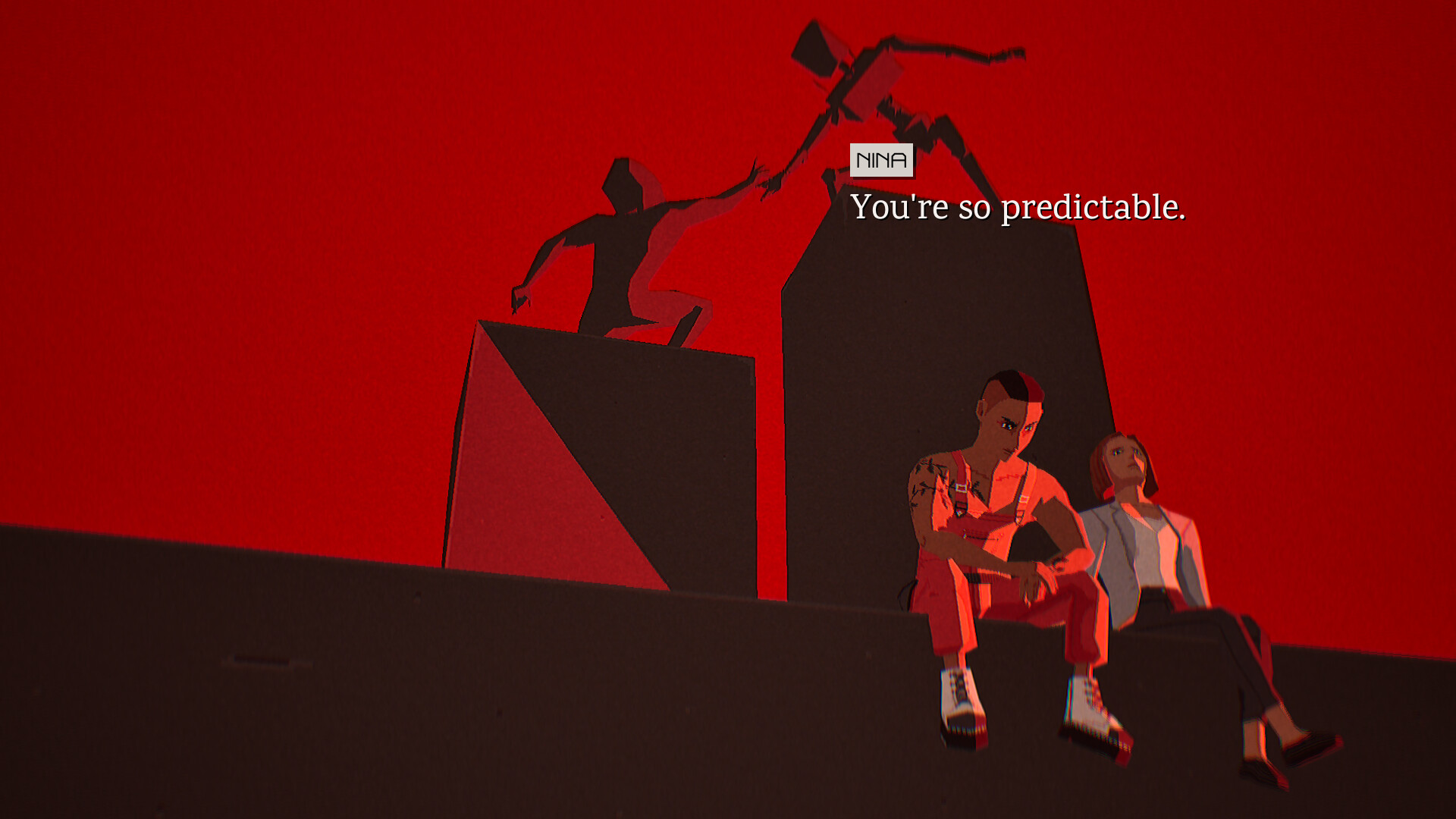
The characters all animate well and control over Pratelle, analog stick to move, trigger or face buttons to swing the sledge, is easy and fits the narrative. There is no option to run, something the community asked for as part of the demo feedback this title received, which is something the developers said they considered but left out as to not distract from the story being told. This is not an action adventure; it’s an interactive narrative. The color palette is used really well and leads to some truly beautiful scenes. The soundtrack is also fantastic featuring a synth heavy, digital sound that works to enhance the mood of the story.
For all that Virtue and a Sledgehammer is there is one thing it clearly is not, a game in the traditional sense. This is interactive fiction, more concerned with telling its story than having a fun time in the way a game about destruction might seem usually geared. And honestly, it really, really works. It’s a relatively short experience, about 3 and a half to 4 hours depending on how deep you explore every nook and cranny. The story is heavy with themes that will hit home for a lot of people. There’s also a deeper message about the dangers of AI and the loss of humanity to technology at play that is unfortunately only going to get more and more prescient. It’s impossible to go too deep without venturing into full on spoiler territory. It’s not for everyone though and I would definitely recommend playing the available demo first or watching some gameplay before diving in. If this seems like an experience you’d be into, I whole-heartedly recommend it. It’s not often the ending of a story makes me sit quietly for a bit. Virtue and a Sledgehammer has things to say and does so in a beautiful way.
Review copy of game provided by publisher.