

Square Enix puts a new coat of paint on the origins of Mystery Dungeon
Square Enix made a bunch of longtime fans of Dragon Quest very happy on 9/9 with the surprise release of a DQ spinoff that had long been a Japanese exclusive. Dragon Quest Heroes: Torneko’s Mystery Dungeon – Classic HD is more than a ridiculously long title. It’s an HD version of the foundational game in the Mystery Dungeon series (which has spun off into franchises like Shiren the Wanderer, Final Fantasy, and Pokémon) as well as a throwback to when “roguelike” wasn’t just a buzzword and the games were really, well, Rogue-like.
Originally released in 1993 on the Super Famicom (as Torneko’s Great Adventure), the game follows Torneko Taloon (a merchant, and one of the hero characters from Dragon Quest 4) as he sets off to realize his dream of settling down and building a retail empire with his wife and son. Torneko soon learns of a mysterious dungeon (so it’s not just a clever name!) that contains a secret treasure, and he and his family pick up stakes and set up shop nearby. The king will only allow Torneko to search for the treasure if he proves himself by retrieving a box from a small dungeon as a test.
MSRP: $24.99
Platforms: PC (reviewed), XBOX, PlayStation, Switch
Price I’d Pay: $15
The small dungeon serves as the tutorial of sorts for the game and is a great introduction to the basic concepts, you’ll be battling as you make your way through. For those of you who haven’t played any of the mystery dungeon games (or who may be unfamiliar with the original Rogue from 1980), these games can be punishingly difficult, heavily based on RNG success, and require strategic thinking all the way down to your individual steps within the dungeon. Completing the tutorial dungeon unlocks the full mystery dungeon, which is where the real game begins.
The basic layout is simple enough. You enter a randomly generated dungeon with one goal, make your way deep into the dungeon one level at a time, find the special treasure, and get out. Easier said than done of course, with progressively more devious and difficult enemies trying to end your dreams of wealth and prosperity before they get off the ground. Torneko is a capable fighter, but he’s no great warrior striding into the enemies lair clad in shimmering armor. You will (to start anyway) be wading in to this wretched hive of scum and villainy with nothing more than the clothes on your back and a loaf of bread your sweet wife baked you for lunch.
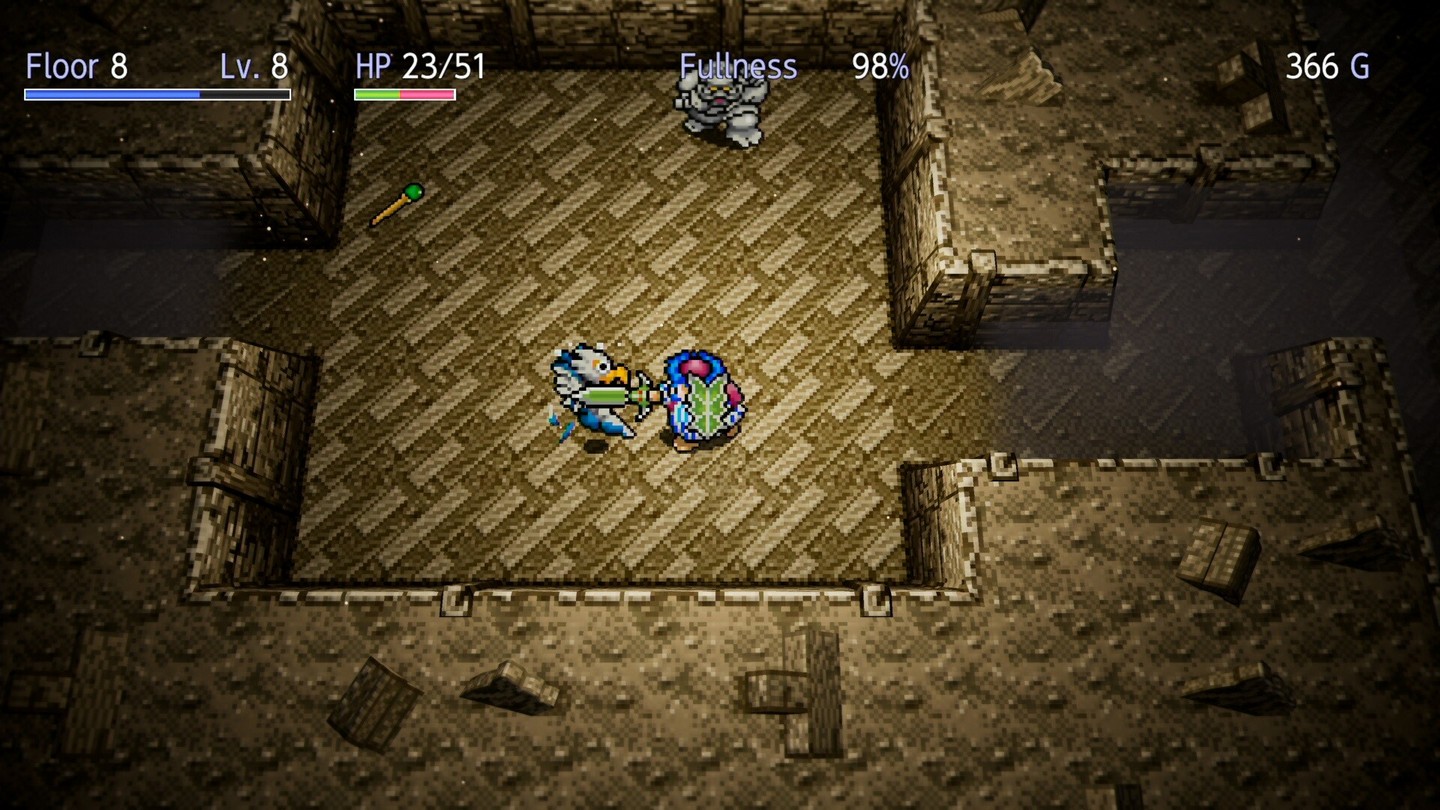
As you explore each level of the dungeon, you’ll be increasing your capacity for violence and survival in two major ways: by collecting equipment, supplies, and miscellaneous floor plants and by turning every slime, platypunk, and funghoul in your path into a skid mark on the dungeon floor. Equipment takes a couple of forms. You’ll find weapons throughout the dungeon that increase your attack damage and with luck you can find +1/+2/+3 etc. versions of the weapons which add to your attack even more. Shields perform a similar function on the defensive side and serve as Torneko’s only real form of armor. Torneko can also perform some attacks at a distance by finding wands and collecting arrows, which can help with spacing and crowd control. With respect to support equipment there’s all manner of herbs, scrolls, and food items which can help increase Torneko’s staying power and survivability by upgrading his equipment, refilling (or even increasing) his HP, or just setting off a huge explosion to take out a large number of enemies at once. All of these will be immediately familiar to long-term fans of the Dragon Quest series.
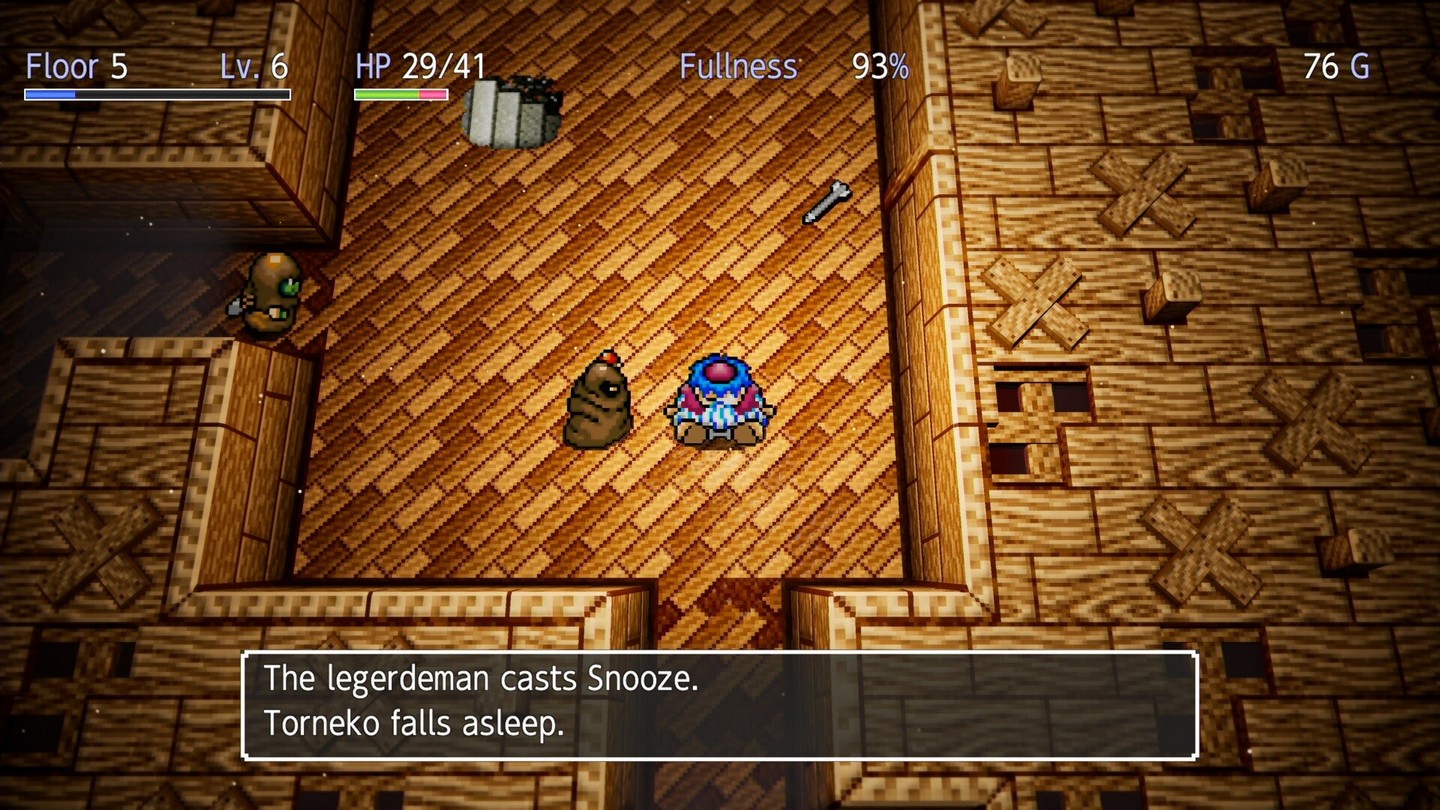
Combat and movement are closely intertwined in this game in ways that make deeper levels more akin to chess than a traditional turn-based RPG. To paraphrase the great modern philosopher Sting, “Every step you take, every move you make, the monsters are watching you”. Basically, any action except turning to face an enemy or opening your inventory counts as your “turn” and so, any enemies in the dungeon will also get a turn each time you take a step, use an item, or swing your sword. The tutorial dungeon and the first 10 or so floors of the mystery dungeon can be completed with a limited amount of thought paid to each step when enemies aren’t right next to you, but as you progress in the game you’ll need to be much more judicious with your steps to avoid traps, manage the hunger meter that is always counting down, and ensure that more aggressive and dangerous enemies are held at bay.
I found that once I made it to floor 15 or so, I was avoiding more enemies than I was battling, and by the time I got to floor 20 I was almost exclusively avoiding enemies. In this way, my strategy changed as I made my way through the dungeon. On higher floors I was doing more exploring, killing more enemies for XP, and searching for better equipment. On deeper floors I was trying to make a beeline to find the stairs down to the next level and hoarding “panic” items like herbs that make enemies flee or Bang scrolls that damage a lot of enemies at once. In this way, the game started to feel more like survival horror than an RPG by the time I got close to the treasure.
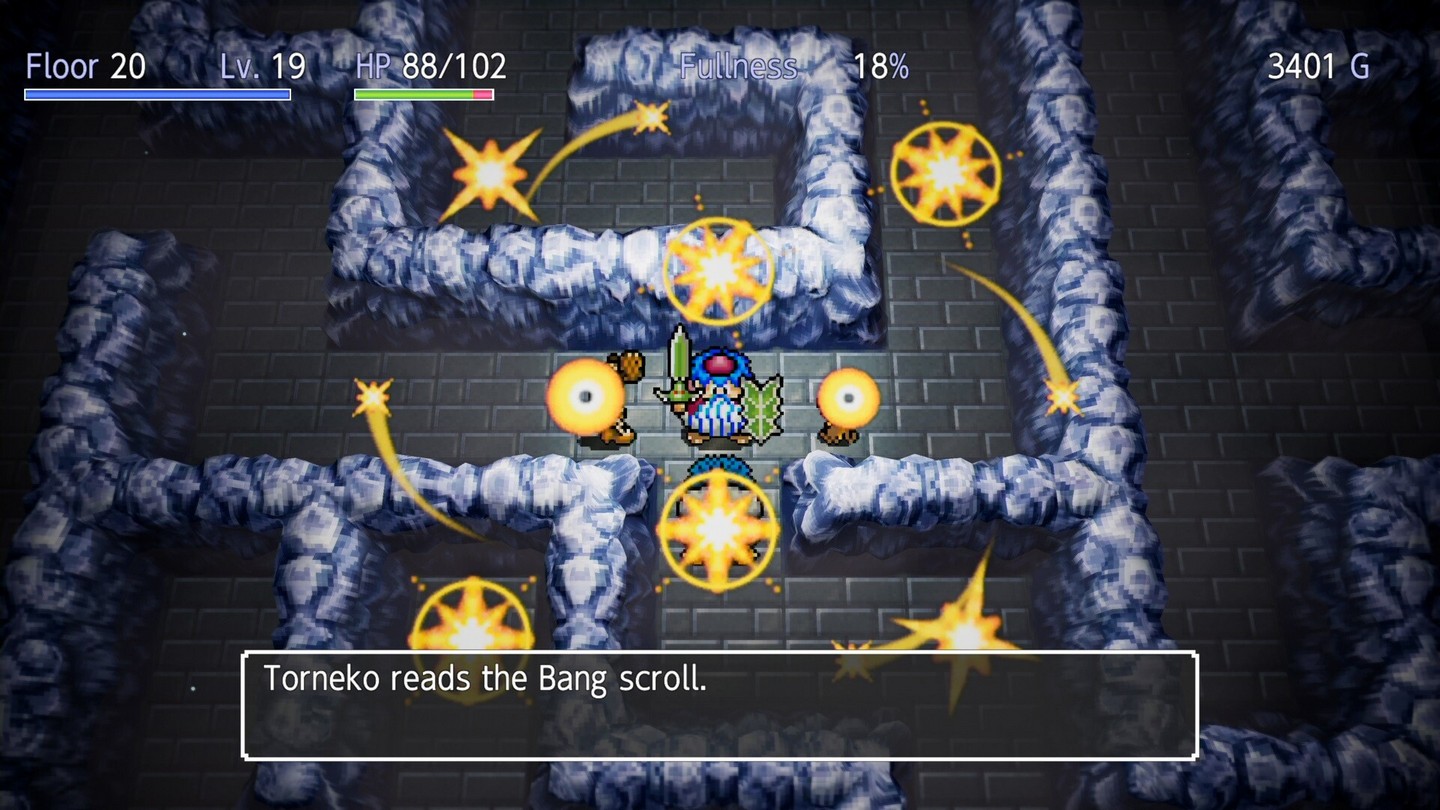
Now is a great time to mention that, in true Rogue fashion, each run sees Torneko start over in terms of character level (achieved through gaining XP by killing monsters and helping to multiply your attack and defense stats and increase max health) and equipment. That’s right, when you die in this game your next run will be as a level 1 Torneko with a large bread loaf in your backpack back on the first floor of the dungeon. As you build out your shop on the surface you’ll gain access to a storeroom, which lets you offset some of this by carrying 1 (and later multiple) previously found items with you on your next trip into the great unknown but only if you’ve managed to escape the dungeon while carrying those items and placed them in the storeroom instead of selling them. This adds a tremendous amount of replayability to the game, and I found myself very excited to see what the next stage of the buildout of my shop would look like and provide as a benefit.
A run ends through one of three ways: Torneko dies and loses half of his earned coins and all items, Torneko finds an evac scroll which allows him to exit the dungeon at any time with all of his coins and any items he’s collected along the way, or Torneko finds the special treasure (usually on a floor in the high twenties) and makes his way all the way back up and out of the dungeon (which “completes” the game and unlocks the “More Mysterious Dungeon”). Evac scrolls are very rare, but the game does provide a little respite in the form of a Steel Lockbox that always appears on level 10 and allows you to keep all of your coins if you die. If you die, you’re presented with the option of either going back to your shop or starting the next run immediately with just a Large Loaf in your inventory, making it very easy to bounce from one run to the next.
This loop is incredibly addictive and their tagline of “The RPG that can be played 1,000 times” is very accurate. I found myself stuck in the “one more run” mindset more than with most other recent games of this type and the evolving nature of the strategy required as you get deeper into the dungeon, the heavy impact that RNG plays on your success rate, and the randomly generated dungeon floors makes for an experience that is quite literally different every time. Others who have cut their teeth on more recent games in the roguelike genre may feel like what’s on offer here is a bit dated however, so it’s helpful to know what you’re getting into before you pick this one up. This isn’t the type of roguelike where you can power level your way through by piling up a bunch of runs and maxing out a Skill Tree. At best you’ll be able to start each run with a couple of extra items in tow, but your level is still starting over at 1 regardless.
Helping to beat this dated feeling is the fact that this remastered package includes several quality-of-life improvements intended to spruce up it’s more than 30-year-old foundation. You get improved visuals (the original Super Famicom still looks great but this version includes widescreen and HD support). The menus and GUI look very similar to the recent Dragon Quest remakes on IOS. You also get some difficulty sliders and a DLC which is made for audience interactivity when streaming the game.
One area that isn’t an improvement over the original is the pacing of the game while you’re in the dungeon. Torneko will get plenty of text updates in the “log” on the screen as you play, particularly in combat. Typical Dragon Quest stuff like “Torneko hit the Ghost for 4 damage”. These text logs slow down the pace of the game considerably, particularly when missing in combat or leveling up. Having to press a button to dismiss each of these adds additional button presses and is a bit of a drag on what could have been slightly faster combat. This is more noticeable if you’ve played other Mystery Dungeon games (or the original of Torneko) however, and if this is your first one you probably won’t have as much issue. Hopefully this is something that can be addressed in future patch. As it stands, it doesn’t ruin the experience, but it does interfere with the flow of the game.
Another negative in my book is the price. This HD remake is launching at $24.99 which feels $5 – $10 heavy in my opinion, especially if you’re not a big Dragon Quest fan. There is a ton of replayability here, which helps, but there aren’t enough QOL improvements from my perspective over the original rom to justify that full price.
All in all, I’ve had a wonderful time with Torneko. As a big Dragon Quest fan i have a built-in appreciation for the character anyway and the adventure on offer here is an addicting and rewarding way to kill some time and slimes. I do wish we had gotten some additional visual, QOL, and mechanical adjustments with the package, however. If you’re the type of person who loves old-school challenges, strategic decision making, and isn’t turned off by the risk of losing everything and starting over again you’ll find a lot of enjoyment here. Just make sure you know what you’re getting into, because one more run may just turn into 1,000.
Review copy of game provided by publisher.