

Grasshopper reimagines a classic
When broken down to its core components, Romeo is a Dead Man is a story about a small-town police officer who works alongside the FBI after rescuing a mysterious woman named Juliet. It all sounds grounded and cohesive until you remember that this premise has been filtered through Suda51’s brain, meaning Romeo is actually a half-dead man who has been turned into a tokusatsu zombie by his grandfather, the FBI branch he works for hunts time-traveling criminals, and the amnesiac woman might be a psychopath who wants to destroy reality.
If it wasn’t fairly obvious already, Romeo is a Dead Man’s plot is intentionally bizarre, following the rule of cool first and foremost. It becomes clear that nothing is meant to be taken seriously early on when a character dies and later shows up again claiming to have come from an alternate dimension. Anyone familiar with Suda’s previous works is most likely already on board with this unconventional style of storytelling, but those that are new to it better strap up, as weirdness is commonplace when working for the FBI’s space-time police force.

MSRP: $49.99
Platforms: PC (reviewed), Xbox, PlayStation
Outside of gameplay, Romeo is entirely built on mixed media, featuring a wide variety of art styles that include old-school anime eyecatches, mock visual novels, album covers, ASCII, pixel art, and comic book-style cutscenes, all contrasting against the game’s ultra-realistic levels that make full use of the Unreal Engine 5’s graphical capabilities, for better or for worse.
Each stage is pretty straightforward for the most part, having you fight your way through hordes of zombies while weaving between reality and a digital realm called the subspace, which is used as a shortcut to reach locked areas. Some levels shake up this structure with a unique gimmick, like turning into a stealth horror section halfway through, but throughout most of the game they are simple and disappointingly linear, making it clear that its slick presentation ends as soon as the gameplay starts.
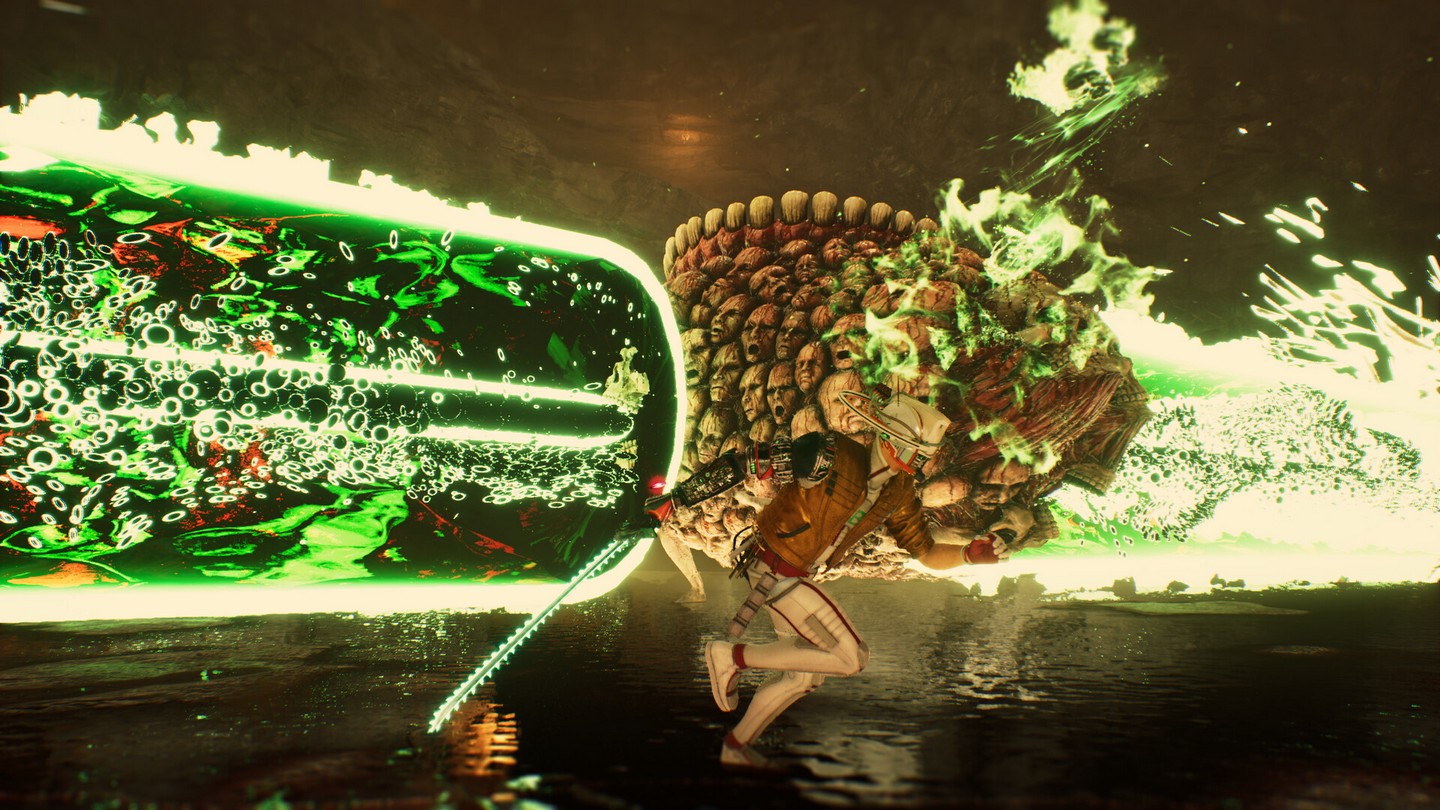
Despite being given access to a varied arsenal of ranged and melee weapons, fighting enemies eventually becomes a formality rather than something enjoyable, as Romeo’s guns are well-rounded but deliver a pitiful amount of feedback when used, while his melee weapons feature movesets (very generous usage of the word here) that consist of three combos at most. It also doesn’t help that the game’s enemies are prone to just standing around or getting stuck whenever an elevation change happens, although they aren’t all that fun to fight when working properly either.
Some minor issues also include long animation locks after each attack, the lock-on not moving to a new enemy after death, no invincibility frames after being hit, the camera being way too zoomed in, and the fact that groups of enemies can lock you into place by mobbing you, sometimes immediately as you come out of a loading screen. The overall stiffness of its combat seems intentional to a certain degree, as some upgrades rectify things like the slow aiming speed, but there’s never a point where combat feels fun or fluid.
There is one small highlight when it comes to the game’s combat, however, which is the bastard system. Every enemy has the chance of dropping a seed, which can be planted and harvested into a friendly zombie who performs different moves when called into battle. Looking for rare seeds and upgrading your zombies is surprisingly engaging, and their active skills are all incredibly useful, allowing you to either deal massive damage to enemies or take a breather by knocking them down.

Suda’s work as a writer also leaves a bit to be desired this time, as early on we are shown a comic book montage of Romeo fighting against a wide variety of Juliets, one being a giant witch, the other being a Doom Slayer-esque marine, and a few others, which feels like a much better story than the one we actually got. The game already flirts with a time loop in the way it introduces each chapter, so it could very well add Juliet into the mix à la Slay the Princess, but instead it opts to waste most of its runtime on a set of villains who have nothing to do with Romeo before delivering an incoherent ending.
Romeo is a Dead Man is experimental in all the right ways when it comes to its aesthetic and visuals but forgets to try anything new when it comes to its gameplay. The game does pick up in its second half, featuring better bosses and levels, but at that point it is simply too little too late. Fans of Suda’s existing body of work will most likely be able to set these issues aside, but between the poor PC performance, stiff gameplay, and frustrating story, it becomes very difficult to enjoy this piece of ultra-violent science fiction.
Review copy of game provided by publisher.