


An ever shifting planet, a consistently excellent experience
Let’s get the obvious questions out of the way; if you loved Returnal you will love Saros. If you liked Returnal, you will like and maybe love Saros. If you didn’t like Returnal because it was too hard or the runs were too long, there’s a good chance you’ll like Saros. If you have absolutely no idea what Returnal is, you might still very well love Saros. It’s the spiritual successor to one of the PlayStation 5’s most underappreciated titles, Returnal. It takes everything that developer Housemarque is known for and refines it to a far more engaging, forgiving, and overall enjoyable experience.
Saros is set on the alien world of Carcosa, a hostile, ever-changing planet that is far darker than it seems on the surface. As part of Echelon IV, player character Arjun Devraj is tasked with investigating the mysterious disappearance of Echelons I, II, and III. It’s more personal than that, though, as Arjun is also looking for someone special to him. Throughout the course of the game, the realization of what is actually happening on the planet of Carcosa becomes more and more clear. Scattered throughout the world, about halfway through each biome, Arjun discovers a pool with more hands than is realistically comfortable sticking out of it. Interacting with them triggers an eclipse which at first seems like nothing more than an excuse to have the world get a bit darker and the enemies a bit tougher. Like so much in this game, though, it’s not that simple. In astrological terms, the Saros cycle is an 18-year, 11-day, and 8-hour period used to predict solar and lunar eclipses, which was discovered by Babylonian scholars. This fact begins to play heavily in the development of the story of Saros, and while I won’t be spoiling anything here, players can expect a tale that is as shifting as the planet it takes place on.
MSRP: $69.99
Platforms: PlayStation 5
Price I’d Pay: $69.99
There are some truly spectacular moments where the plot becomes so much more than the opening sequence would have you believe. If the name Carcosa seems familiar, that’s not by accident. If you know about the King in Yellow, and the cosmic horror stories where that name/character/trope appears, you’ve got some idea of where things are going. There is some wonderful acting by Rahul Kohli, who you might recognize from the fantastic Netflix series The Fall of the House of Usher or the slightly less fantastic CW series iZombie. Jane Perry, Returnal’s lead character Selene, plays Echelon IV lead Sheridan Bouchard, the “company is right above all else” commander of the mission. A solid roster of both voice and live action actors round out the cast and deliver spot-on performances. In their most story focused game to date, Housemarque went all out, and it shows. Whether it’s through the end of section transitions, the text and audio files found in-world, or dialogue between characters, the story is delivered in perfect little chunks that made me want to keep pushing forward to find out just what exactly was going on.
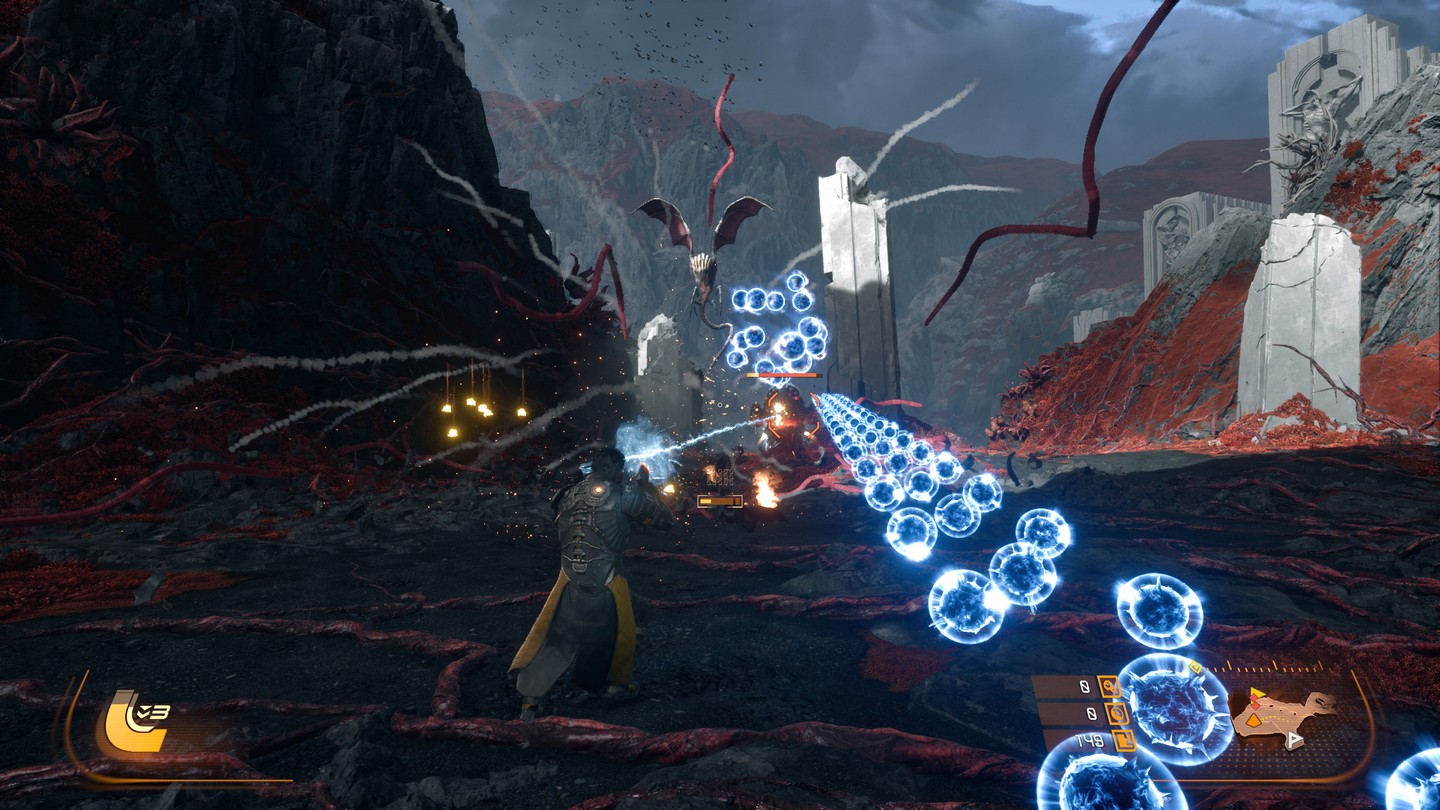
Progressing through that story is where Saros really shines. Housemarque has a reputation for making excellent games with tough as nails but interesting and intuitive combat. Returnal really is a fantastic game, but I’d guess that a lot of players never made it to the end due to the difficulty spikes and loss of progression upon death. Because make no mistake, Saros is a game where you are going to die, a lot. It’s the very nature of a rogue-like to try, fail, and try again. Saros makes that process much more forgiving. Combat in Saros is what Housemarque affectionately calls “bullet ballet.” If you’ve played their previous titles, then you have a bit of an idea as to what that means. Where they’ve made a massive improvement for Saros, though, is in the Soltari Shield. By activating the shield, players can absorb enemy projectiles of certain colors, one color at the start and one through upgrades. It works a bit like the bullet absorbing mechanic in Ikaruga where absorbed projectiles translate into weapon energy. Once charged, Arjun can unleash a devastating attack that comes in really handy during boss battles. But make no mistake, Saros is a bullet hell shooter, just in 3rd person. The amount of projectiles on screen at a time can be borderline overwhelming. Thankfully the shield, as well as the ability to dash, and later grapple, gives players the ability to navigate this particular ballet.
Arjun’s charged attack, as well as the various weapons scattered throughout the game world, can all rise in level the deeper you go, which leads to another of this game’s highlights, the weapon variety. From pistols to rifles, shotguns to Carcosian tech, there is a wide variety on display. Each weapon features a secondary fire option and buffs or nerfs depending on where you are in a particular run. This variety lets players build their runs around their preferred playstyle. The options go a long way in making Saros more manageable. Where Saros takes big leaps forward is in the permanent progression system and Carcosian modifiers. Permanent upgrades make the overall experience more “trial and error” than punishment, since the penalty upon death is nowhere near as detrimental as it is in other games of this type. If you find yourself in an area that’s a bit too much, just give it a minute. You’ll get there. Carcosian modifiers further this design philosophy. These modifiers give players the option to make the game a bit easier. For example, you can reduce incoming damage/increase outgoing damage at the cost of keeping things balanced, taking away an artifact (power-up) per level. This system operates on an easy-to-read dial that gains more options the deeper you go. (Players can also choose to make the game more difficult, if that’s what they’re after)
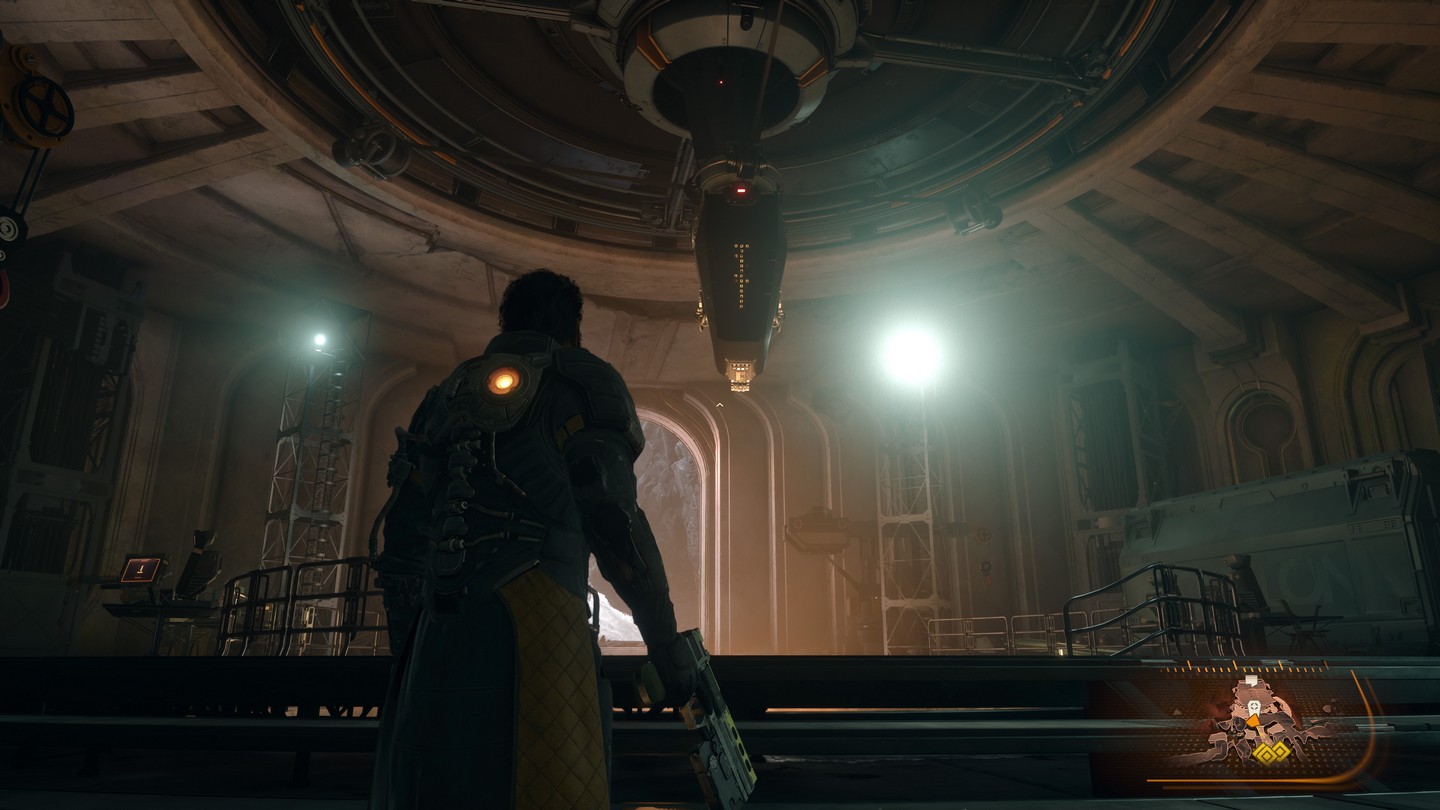
Graphically, Saros is very impressive. I ran through it on a standard PS5 and the Playstation Portal, and the entire experience looked and played beautifully. There is no option for performance versus pretty, which is fine by me. Character models are all well-detailed and different enough that it’s easy to keep track of who’s who. Enemy types are diverse as well, ranging from mechanical horrors to giant, screen filling beasts. The various colored projectiles are all easily readable in combat situations, allowing players to react as needed. Carcosa itself is wildly different from location to location, all while feeling like it’s part of a larger whole. The ever-present sun, pre and post eclipse, provides a gorgeous backdrop for the cosmic horror setting. There are some truly breathtaking sections of this game that honestly make me really wish I had a PS5 Pro, as the game does feature an enhanced mode.
The sound design also stands out. Enemies approach from all sides and playing with 3D surround sound either through speakers or headphones heightens the intensity of the combat. The soundtrack features a wide range of tracks from haunting to driving, all of which fit their scenes well. Sam Slater, two-time Grammy winning composer, has put together a score that feels a part of the world rather than a reaction to it. Like the game itself, it’s deeply layered, and far more complex than what it appears to be.
Overall, Saros is a fantastic experience that should not be missed. Housemarque has taken what worked for them previously and made it better. More importantly, they’ve taken the negatives from previous releases and assessed them honestly, allowing them to turn said negatives into positives. There are some balance concerns present in this pre-release review copy that may or may not be ironed out with patches later. Even so, they’re not so jarring as to ruin an otherwise outstanding game. Saros is Housemarque operating at the peak of their powers.
Review copy of game provided by publisher.