


A Bolt From the Blue
After an odyssey Dotemu and Triskell Interactive return bearing with them Theos: Cities of Myth. Has Icarus flown too high? Or has Triskell managed to make lightning strike twice?
To address the titan in the room, comparisons are inevitable to Impressions Games’ Zeus: Master of Olympus and Triskell’s previous contribution to the genre, Pharaoh: A New Eden. Unlike with A New Era’s direct connection to Pharaoh, one can only speculate if the Zeus license was tied up, or if it was by design to distance Cities of Myth from Master of Olympus, especially when considering how clearly Theos carries the torch of Zeus’ Promethean fire.
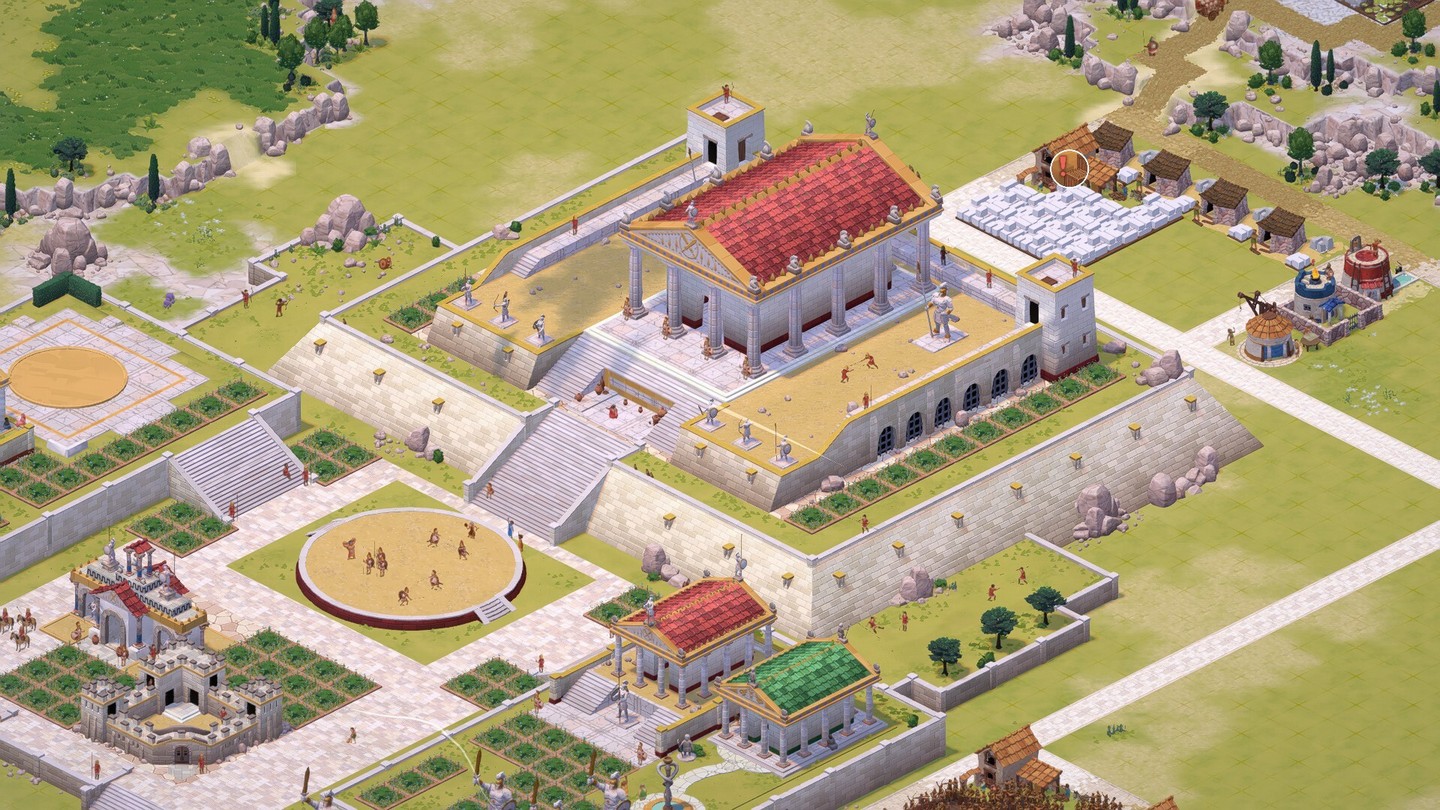
Theos’ design decisions harken back to its spiritual predecessor. Labour is global, goods are distributed by agoras, religion is worshiped in single centralized sanctuaries, trade makes the drachma flow, and the Gods walk the streets in physical manifestation. Structures have a larger physical footprint on the map grid than Pharaoh. Military campaign has a greater focus; the player writes their own Iliad through extortion, vassalization, and the conquering of neighbouring city-states. Systems absent from Zeus but present in Pharaoh reappear in the form of water, crime, and a larger variety of safety watchposts. Gone (thankfully) are byzantine labyrinths of street pathing designed to shepherd walkers, replaced entirely with direct control over walkers’ routes on a per-structure basis.
MRSP: $19.99
PLATFORMS: PC
PRICE I’D PAY: $19.99
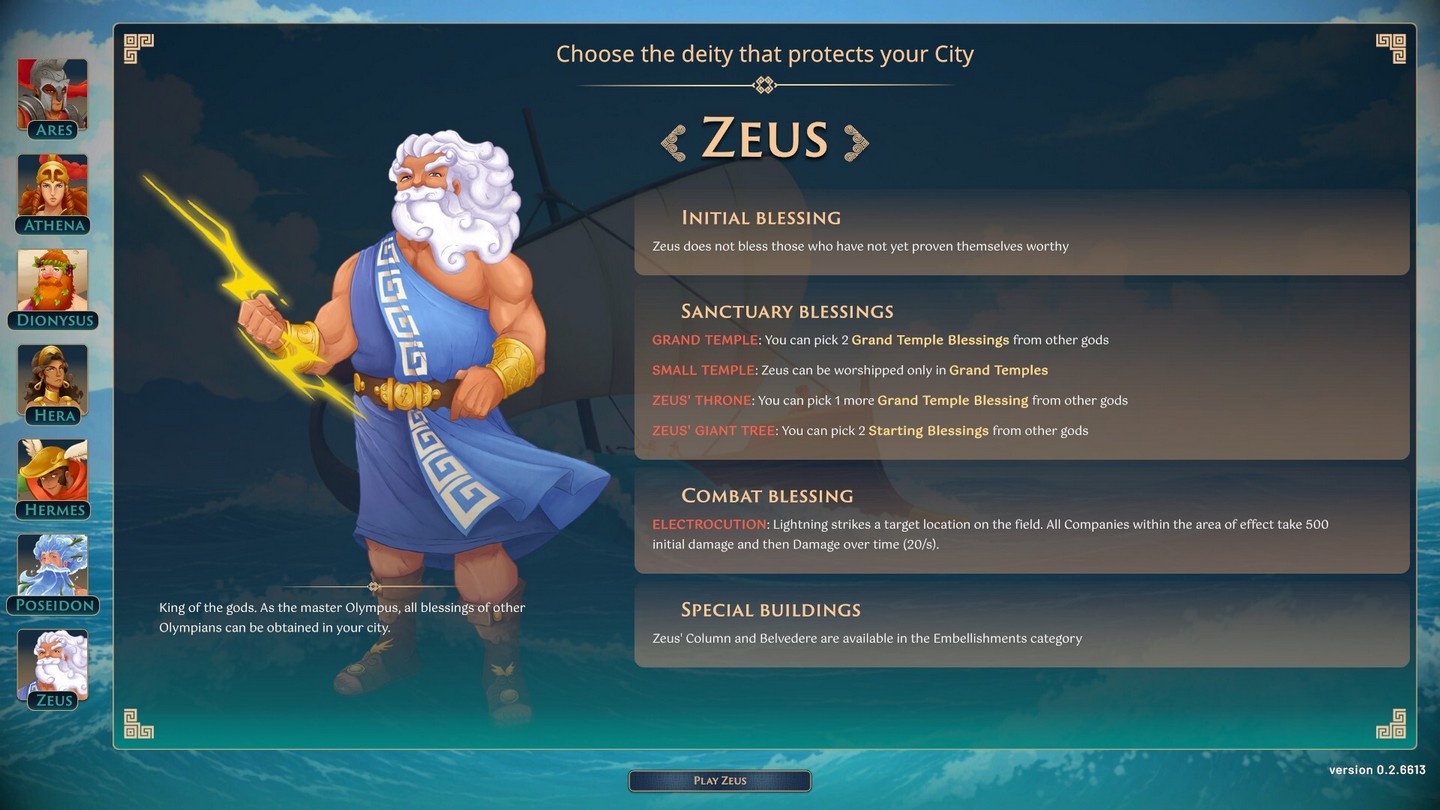
Your Grecian polis begin with their patron’s sanctuary selected from among the famed Twelve Olympians. From Ares and Athena to the mighty Zeus himself, your many labours see you raise a united Greece in the name of your chosen deity. Unlike Pharaoh’s sisyphean task of starting over every colony from nothing, Theos’ ongoing campaign visits and revisits each of the player’s successes, parent city and child colony growing naturally and introducing new resources and mechanics as the chapters progress.
Tantalizing is the news of not just what Theos was, but what Theos is in and of itself. Many aspects of the game are its own wholly unique designs, untethered from basis on past Impressions Games DNA:
- The military branch has been completely redesigned; your nation’s standing army now incurs its own demands for goods and service to develop and remain fighting fit, leading the player into designing military housing blocks centralized around their barracks.
- Theos further tempts you to open its pandora’s box with Great Persons, attracting named philosophers and heroes from Greek history and myth to your city to provide a myriad of bonuses.
- In a genre first, Theos introduces real time access to your other colonies with the ability to switch mid-mission to view and edit, to manage trade, and further develop cities under your dominion at your leisure.
Visually we are all Orpheus looking back upon Zeus’ Eurydice, only to discover Theos is just as beautiful as the day we had to leave Zeus behind on the x86. While A New Era remained 2D like its predecessor, Theos’ graphical style has taken the leap from 2D into fully modeled 3D. Where Zeus’ bore a somewhat larger-than-life stylized and exaggerated art style, Theos has developed a look grounded in realism. Every temple, statue, and structure is now lovingly modeled, with the player given (somewhat limited) camera control to gaze narcissistically at their own accomplishments. Like an ant terrarium, watching well built polis is its own reward.
Likewise the UI is of its own design. While A New Era’s harkened to a more faithful reproduction of Pharaoh’s layout, Theos’ has been redesigned from the ground up and sports a width-first layout better suited for modern widescreen displays.
If you have played Zeus or A New Era, there is no barrier to entry; you already know how to play. Triskell has kept what worked and upgraded what didn’t. For those new to the genre, Theos: Cities of Myth features a robust set of tutorials to dip one’s toes into before venturing forth to build your personal polis.
The Bad: I won’t sugar coat it. The series’ personal nemesis remains at large: Combat. It’s not good. As of the early access press release branch the combat is frustratingly bad. It was bad in the original Pharaoh, and A New Era improved it by neatly removing it in its entirety. Theos takes another crack at the concept, to mixed results.
Combat now takes the form of an abstracted arena of the terrain around a representation of a city to attack or defend. Its greatest stumbling block is in the control scheme; while being inspired by the RTS genre, it lacks all of the nuance on input control which RTS’ favour. No attack move, no action queuing, and most jarringly the click to select a unit is also the same input to issue an order. Theos’ combat falls flat on its face as you regularly attempt to select a soldier only to issue an order on an already selected soldier to break ranks and rush over to your intended selection target. If these elements can be improved, Theos will have won me over completely.
(At time of writing this reviewer has over 200 hours in Pharaoh: A New Era and fully expects Theos: Cities of Myth to consume in equal measure)
Review copy of game provided by publisher.